

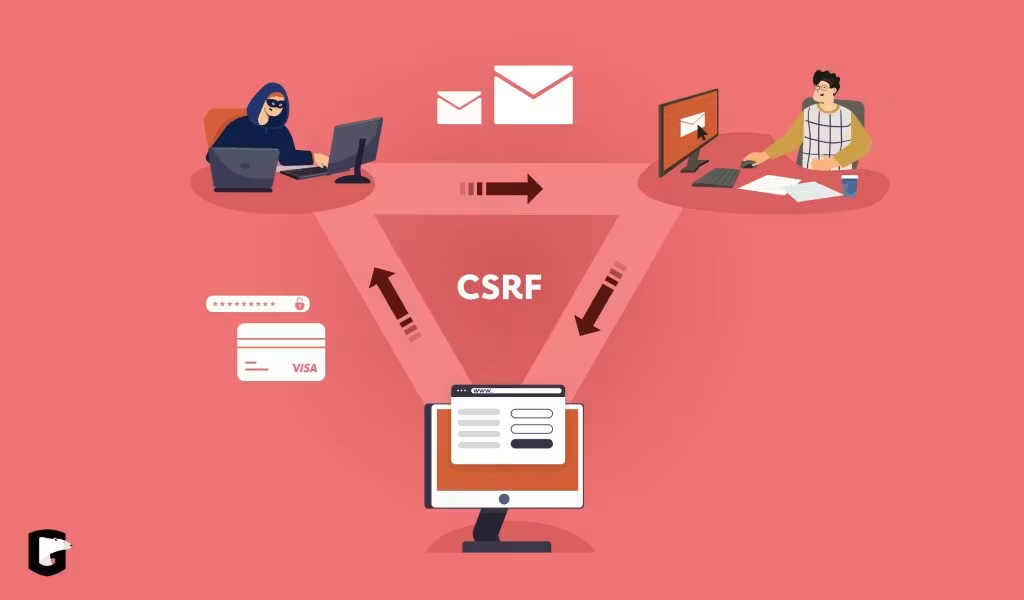
Jakarta, odishanewsinsight.com – CSRF Protection is a critical web security practice designed to prevent attackers from tricking authenticated users into submitting unintended requests to a web application. In a cross-site request forgery attack, a malicious site or crafted request exploits the fact that a user’s browser may automatically include authentication credentials such as cookies when interacting with a trusted application. Without proper defenses, actions like updating account settings, changing passwords, or initiating transactions could be triggered without the user’s real intent.
What makes CSRF Protection especially important is that these attacks often target trust rather than code execution. The application may function exactly as designed, but it accepts a forged request because it cannot distinguish between a legitimate action and one initiated by an attacker through the user’s active session. That is a rather rude abuse of browser helpfulness. Effective CSRF protection ensures that sensitive requests are both authenticated and intentionally made by the user.
What CSRF Protection Is

CSRF Protection refers to the set of techniques used to stop cross-site request forgery attacks by verifying that state-changing requests come from legitimate, intended interactions within the trusted application. It is especially important for applications that rely on cookie-based authentication, where browsers may automatically send session credentials along with requests.
Common mechanisms associated with CSRF Protection include:
- Anti-CSRF tokens
- SameSite cookie settings
- Origin and Referer validation
- Re-authentication for sensitive actions
- Custom request headers
- Secure session handling
- Form submission validation
- Defense-in-depth security design
These mechanisms explain why CSRF Protection is essential for safeguarding authenticated user actions.
Why CSRF Protection Matters
CSRF Protection matters because authenticated sessions create opportunities for attackers if requests are not properly validated.
Protects User Intent
It ensures that actions performed under a user account are genuinely initiated by that user.
Secures Sensitive Operations
It reduces the risk of unauthorized changes, submissions, or transactions.
Supports Trust in Authenticated Systems
Users expect account actions to require their real participation, not just an active session.
Strengthens Web Security Posture
It complements other controls such as authentication, session security, and input validation.
Helps Prevent Silent Abuse
Many CSRF attacks are invisible to the victim unless protections are in place.
These strengths explain why CSRF Protection is a foundational part of secure web application design.
Core Characteristics of CSRF Protection
Its role becomes clearer when its key defenses are viewed together.
| Characteristic | Description | Why It Matters |
|---|---|---|
| Request validation | Confirms that incoming requests are legitimate | Prevents forged actions |
| Token-based defense | Uses unpredictable values tied to user sessions or forms | Blocks attacker-crafted submissions |
| Browser-aware controls | Uses mechanisms like SameSite cookies | Reduces cross-origin credential misuse |
| Sensitive action hardening | Adds extra safeguards for high-risk operations | Improves security for critical workflows |
| Layered protection | Combines multiple techniques rather than relying on one | Increases resilience against bypasses |
Together, these characteristics show why CSRF Protection is vital for defending web applications against cross-site request forgery attacks.
How CSRF Protection Works in Practice
In practice, CSRF Protection often begins with embedding a secure token in forms or authenticated requests. When the request is submitted, the server checks whether the token is valid and matches the user’s session or expected context. Additional safeguards such as SameSite cookies, Origin checks, and custom headers help further restrict requests that originate from untrusted sites.
It is especially associated with:
- Cookie-based authentication
- Secure session management
- Form handling
- Account settings protection
- Payment and transaction workflows
- Web application frameworks
- Browser security policies
- Defense-in-depth strategies
This broad relevance shows how CSRF protection fits into the wider architecture of application security.
Common Challenges and Mistakes
CSRF Protection is highly effective, but implementation errors can weaken its value.
Common Issues
- Missing protection on some state-changing endpoints
- Relying only on one mitigation technique
- Improper token generation or validation
- Assuming APIs are safe without checking authentication model
- Forgetting to secure modern asynchronous request flows
These issues show that CSRF Protection must be applied consistently and with awareness of how browsers and sessions behave in real applications.
Why It Remains Important
CSRF Protection remains important because many web applications still depend on session cookies and authenticated browser interactions. Even as frameworks improve default defenses, developers must understand where risk exists and how to secure request flows properly. Attackers tend to favor opportunities created by assumptions, and one common assumption is that a logged-in request must also be a trustworthy one.
It continues to stand out because it provides:
- Stronger protection for authenticated actions
- Better control over state-changing requests
- Reduced risk of silent account misuse
- Layered defense alongside other security controls
- Greater confidence in application integrity
This is why CSRF Protection remains essential for defending web applications against cross-site request forgery attacks.
Final Thoughts
CSRF Protection is one of those security measures that works quietly but matters enormously. It helps ensure that trusted sessions cannot be abused through forged requests and that user actions reflect real intent rather than hidden manipulation. By combining token validation, browser-aware controls, and careful endpoint design, developers can significantly reduce a subtle but serious class of risk.
The key takeaway is simple. CSRF Protection matters because secure authentication means little if attackers can still make users perform actions they never intended.
Explore our “”Technology“” category for more insightful content!
Don't forget to check out our previous article: Crossplatform Apps: Reaching Users on Every Device
