In today’s heterogeneous IT landscape—cloud services, legacy on-prem systems, third-party APIs—getting everything to “talk” can feel like herding cats. Interoperability is the art and science of making disparate systems exchange data and workflows reliably. In this guide, I’ll demystify interoperability, share real-world lessons, and provide you a hands-on framework to connect your technologies painlessly.
What Is Interoperability?

Interoperability is the ability of two or more systems, applications, or devices to:
- Exchange information accurately
- Interpret the exchanged information in a meaningful, predictable way
- Cooperate without special effort on the user’s part
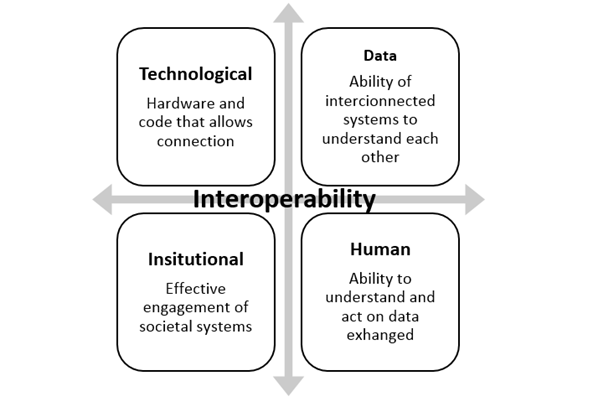
Levels of interoperability:
- Technical – network protocols, data formats
- Syntactic – shared schemas and message structures
- Semantic – common vocabularies and ontologies
- Organizational – aligned business processes and governance
Why Interoperability Matters
- Accelerated Innovation
• Swap or combine best-of-breed components without rebuilding from scratch.
- Cost Efficiency
• Avoid manual data entry, custom bridges, and recurring integration maintenance.
- Better Decision-Making
• Unified data views empower analytics, reporting, and AI/ML models with complete datasets.
- Customer Experience
• Seamless workflows (e.g., single sign-on, cross-platform dashboards) keep users happy.
- Future-Proofing
• A modular, interoperable architecture adapts to new technologies rather than forcing forklift upgrades.
My Real-Life Revelations
- Revelation 1: The Single JSON Schema That Saved Our Project
We standardized on one JSON schema across five microservices. Suddenly, client apps consumed data from any service without code changes.
- Revelation 2: OAuth 2.0 Unblocked Single Sign-On
Integrating SSO with multiple internal tools went from months of custom code to weeks once we adopted a standard protocol.
- Revelation 3: CSV Exports Aren’t Enough
Early on, we relied on ad-hoc CSV dumps for data exchange—only to battle encoding errors, date-format mismatches, and missing columns. Moving to a shared API cut those failures by 90%.
Core Challenges in Achieving Interoperability
- Schema Drift
• Different teams evolve their data models independently, breaking integrations.
- Version Management
• Rolling out changes without disrupting downstream consumers requires careful coordination.
- Semantic Alignment
• The same field (“customer_id”) may have different definitions in different systems.
- Performance & Latency
• Real-time data exchange demands low-latency pipelines and reliable messaging.
- Security & Compliance
• Authentication, encryption, and audit trails must extend across system boundaries.
A Practical Framework for Seamless Data Exchange
- Catalog & Map
– Inventory systems, APIs, data models, and identify overlap or gaps.
- Define Common Contracts
– Create shared schemas (OpenAPI/Swagger, JSON Schema, Avro) and message contracts.
- Choose Integration Patterns
– API-based (REST, GraphQL), event-driven (Kafka, MQTT), or file-based (SFTP, cloud storage).
- Implement Gateways & Middleware
– Use an API gateway or ESB (enterprise service bus) to enforce contracts, handle versioning, and apply security.
- Automate Testing
– Generate synthetic payloads to validate schema conformity, edge cases, and performance under load.
- Monitor & Trace
– Centralized logging, distributed tracing (e.g., OpenTelemetry), and dashboards to detect and resolve errors fast.
- Govern & Iterate
– Establish a cross-team governance board to review changes, approve new fields, and deprecate old versions gracefully.
Common Pitfalls & Remedies
- Pitfall: Building Point-to-Point Integrations
Remedy: Introduce a centralized messaging layer or API gateway to decouple producers and consumers.
- Pitfall: Ignoring Backward Compatibility
Remedy: Adopt the “never break a contract” rule—version new fields as optional and provide fallback values.
- Pitfall: Underestimating Metadata
Remedy: Exchange not just raw data but also context (timestamps, source identifiers, data quality scores).
- Pitfall: Lack of Stakeholder Alignment
Remedy: Hold regular “schema sync” meetings with all teams that touch shared data models.
Tools & Standards
- API Description & Testing
• OpenAPI/Swagger, Postman, Swagger UI
- Data Streaming & Messaging
• Apache Kafka, RabbitMQ, MQTT, AWS Kinesis
- Schema Registries
• Confluent Schema Registry (Avro/JSON Schema), Apicurio (OpenAPI)
- Connectivity Platforms
• Mulesoft, Dell Boomi, Apache Camel, Nifi
- Monitoring & Tracing
• Grafana, Prometheus, Jaeger, Zipkin, OpenTelemetry
Emerging Trends in Interoperability
- GraphQL Federations
• Compose multiple GraphQL services into a single unified API graph.
- Data Mesh Architectures
• Domain-owned data products exposing interoperable APIs and event streams.
- Open Digital Twins
• Standard models (e.g., OPC UA, Asset Administration Shell) for industrial IoT interoperability.
- AI-Driven Schema Mapping
• Machine learning tools that infer and reconcile field mappings between disparate datasets.
- Decentralized Identity (DID)
• Blockchain-based identity standards enabling secure, cross-platform authentication without central authorities.
Conclusion
Mastering interoperability transforms a patchwork of systems into a cohesive, agile ecosystem. By cataloging dependencies, defining shared contracts, leveraging the right integration patterns, and enforcing governance, you’ll enable seamless data exchange, Accelerate innovation, and reduce operational friction. Start small—choose one High-value integration—and iterate, turning interoperability from a headache into a strategic advantage.