

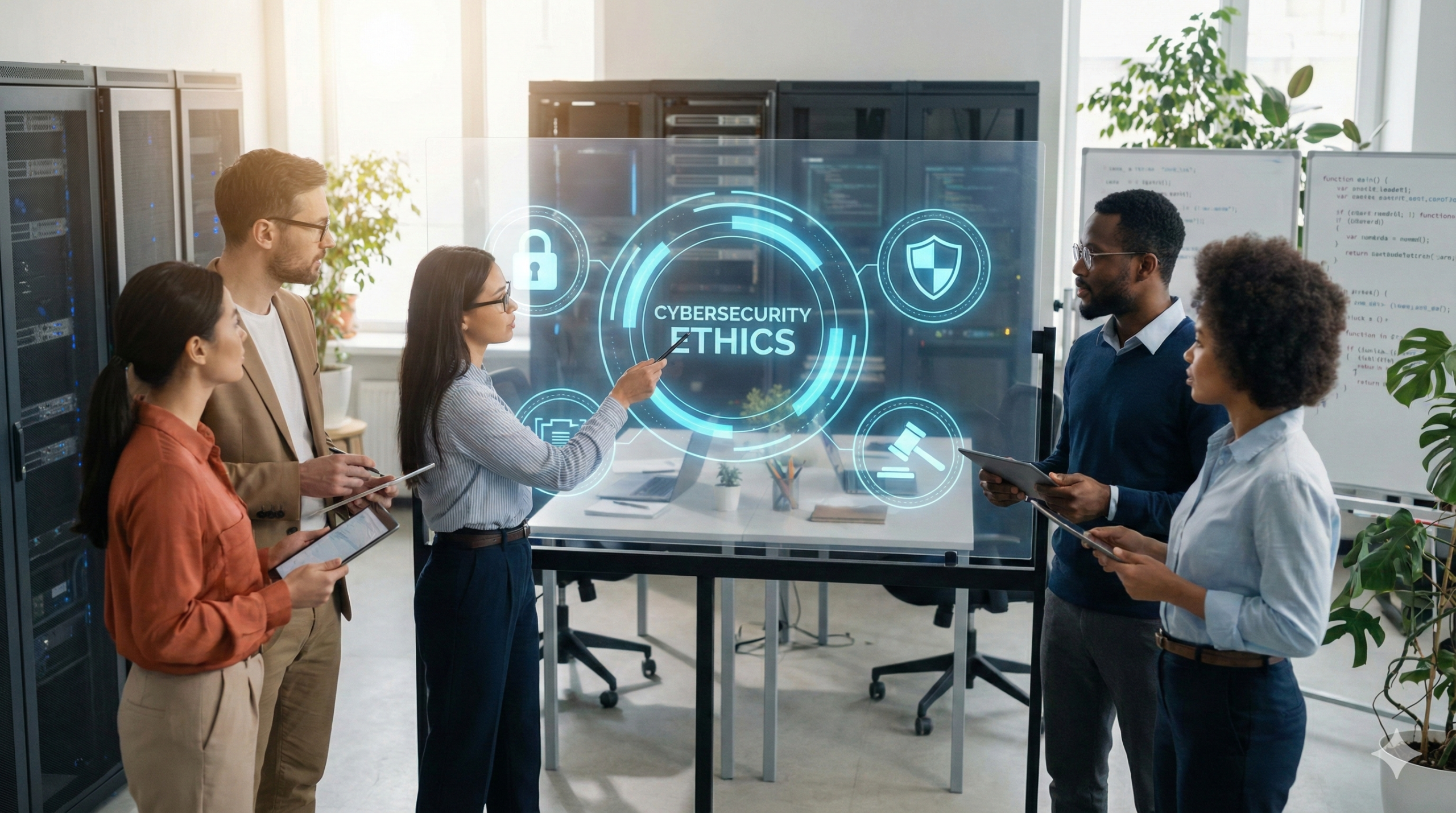
JAKARTA, odishanewsinsight.com – Cybersecurity Ethics: Navigating Moral Dilemmas in the Digital Age. Sounds heavy, right? But trust me, even the most tech-savvy among us trip over the same little potholes. I mean, I’ve been there, staring down tough choices like, “Should I report that data leak at work or hope no one notices?” Spoiler: staying silent was a bad call. Here’s my take on this wild ride called cybersecurity ethics.
Cybersecurity isn’t just about firewalls and intrusion detection—it’s about making values-based decisions when lives, privacy, and trust are on the line. In this guide, I’ll define Cybersecurity Ethics, share my own moral crossroads in security operations, and arm you with frameworks, best practices, tools, and case studies to help you make responsible choices in an increasingly hostile digital world.
What Is Cybersecurity Ethics?

Cybersecurity Ethics is the discipline of applying moral principles to decisions around protecting, monitoring, and responding to threats against digital systems and data. It asks:
- When is it appropriate to monitor someone’s activity?
- How do we balance privacy against national security or corporate interests?
- What responsibilities do security professionals have to report vulnerabilities or breach data?
At its core, it blends technical know-how with philosophy, law, and respect for human rights.
Why Cybersecurity Ethics Matters
- Builds and preserves user trust—breaches of ethics erode reputations faster than data leaks
- Ensures compliance with legal frameworks (GDPR, HIPAA, CFAA) and avoids heavy fines
- Guides responsible disclosure of vulnerabilities, protecting users before criminals exploit flaws
- Balances privacy vs. security—avoids overreach that can lead to surveillance abuses
- Shapes corporate culture, preventing insider threats and fostering accountability
Timeline: Evolution of Cybersecurity Ethics
| Era | Milestone | Impact |
|---|---|---|
| 1970s | Birth of computer ethics (Weizenbaum, “ELIZA” debates) | Sparks discussion on automation vs. human values |
| 1980s | U.S. Computer Fraud and Abuse Act (1986) | Criminalizes unauthorized access—first major cyber law |
| 1990s | Hacker manifesto and responsible-disclosure model emerges | Security community debates full disclosure vs. silence |
| 2000s | EU Data Protection Directive (1995→2018 GDPR) evolves | Elevates consent and data minimization as legal norms |
| 2010s | Equifax, Sony breaches trigger ethics reviews in major firms | Companies start appointing Chief Ethics & Compliance Officers |
| 2020s | AI/ML in cybersecurity raises new bias and privacy concerns | Calls for ethical AI frameworks in threat detection |
Core Principles & Frameworks
- Respect for Privacy
• Limit data collection to the minimum necessary for security. - Transparency & Informed Consent
• Clearly communicate monitoring policies to employees and users. - Proportionality
• Ensure defensive measures (e.g., deep packet inspection) are proportionate to the risk. - Accountability
• Maintain audit logs and decision-making trails for all security actions. - Responsible Vulnerability Disclosure
• Follow coordinated disclosure timelines—notify vendors first, then users. - Non-Maleficence
• Avoid defensive tactics that could harm innocent third parties (e.g., collateral IP blocking). - Justice and Fairness
• Ensure security controls don’t discriminate against or disproportionately impact certain groups.
My Story: Moral Crossroads in Security
- Monitoring vs. Trust
Early in my career, I enabled keystroke logging to investigate insider threats. Although I caught a leak, staff morale plummeted when they learned of the covert tool. Lesson: engage stakeholders and obtain explicit consent before deploying invasive monitoring. - Full Disclosure Dilemma
After discovering a critical zero-day in an open-source library, I wrestled with going public vs. giving the maintainer time to patch. I chose a 90-day coordinated disclosure. While some criticized the timeline, it prevented widespread exploitation in the wild. - Automated Response Gone Wrong
A playbook I wrote triggered a network quarantine for any machine exhibiting anomalous DNS queries. One misconfigured test server got locked out, crippling dev workflows for hours. Lesson: include manual review steps and fail-safe overrides in automated scripts. - Balancing Privacy in Threat Hunting
During a threat hunt, I found personal files on a compromised workstation. I resisted the temptation to review them, reporting only metadata needed for the investigation. Lesson: stick to the principle of data minimization—even when you have access.
Best Practices for Ethical Decision-Making
- Establish a Security Ethics Committee
• Cross-functional group (legal, HR, security, compliance) reviews high-impact decisions. - Adopt a Code of Conduct
• Document clear policies on acceptable monitoring, data handling, and disclosure processes. - Perform Ethical Impact Assessments
• For any new tool or process, evaluate privacy risks, legal obligations, and potential bias. - Embed “Privacy by Design”
• Build classifiers, SIEM rules, and analytics with privacy safeguards baked in. - Conduct Regular Training
• Run tabletop exercises and role-playing scenarios on moral dilemmas (e.g., handling whistleblowers). - Implement Whistleblower Protections
• Provide secure, anonymous channels for reporting unethical security practices.
Tools & Frameworks
| Category | Tool / Framework | Purpose |
|---|---|---|
| Policy Management | OneTrust, TrustArc | Draft and enforce data-use policies |
| Vulnerability Disclosure Platforms | HackerOne, Bugcrowd | Managed coordinated disclosure programs |
| Ethical Impact Assessment Frameworks | IEEE P7000, Data Ethics Canvas | Guide privacy & bias evaluations |
| Privacy-Preserving Analytics | Differential Privacy Libraries | Analyze logs without exposing PII |
| Audit Logging & Forensics | Splunk, ELK Stack | Maintain immutable trails of actions |
Case Study: Ethical Incident Response at AcmeCorp
- Situation
AcmeCorp detected data exfiltration to an overseas IP. Early indicators showed personal customer records were accessed. - Ethical Approach
- Assemble Ethics Committee: Security, legal, and customer-care leads convened within hours.
- Containment with Oversight: Quarantined affected segments under dual control—incident responder plus an ombudsperson.
- Transparent Communication: Notified customers within 72 hours under GDPR guidelines, sharing known facts and remediation steps.
- Coordinated Disclosure: Informed law enforcement and relevant regulators before public announcement.
- Remediation & Follow-up: Offered free credit monitoring, published a post-mortem, and updated security policy to prevent recurrence.
- Outcomes
• Regulatory fines were mitigated due to swift, transparent response
• Customer churn was below industry average for breaches
• AcmeCorp published its first “Ethical Security Report,” boosting investor confidence
Emerging Trends in Cybersecurity Ethics
- AI/ML Explainability
• Demand for transparent algorithms in anomaly detection and user‐behavior analytics. - Privacy-Enhancing Technologies (PETs)
• Adoption of homomorphic encryption and secure multi-party computation in threat intelligence sharing. - Ethical Red-Teaming
• Simulated attacks designed not only to test defenses but also to challenge organizational policies and culture. - Global Regulatory Alignment
• Movement toward unified international standards (e.g., ISO/IEC 27030 series) on ethical security practices. - Digital Human Rights Advocacy
• Security teams partnering with NGOs to safeguard activists and journalists from state‐sponsored threats.
Final Takeaways
- Treat Cybersecurity Ethics as a first-class discipline—integrate moral reasoning into every phase of your security Lifecycle.
- Build governance structures (committees, policies, impact assessments) to guide complex choices under pressure.
- Embrace Transparency and Proportionality—your defensive measures should respect privacy and legal rights.
- Automate Thoughtfully—include manual Oversight and Fail-safes in any Self-Driving Remediation/playbooks.
- Continuously train and test on ethical scenarios so that when real Dilemmas arise, your team makes Principled decisions.
By weaving ethics into your cybersecurity program, you’ll not only strengthen your defenses but also uphold the trust and rights of everyone you protect.
Elevate Your Competence: Uncover Our Insights on Technology
Read Our Most Recent Article About Design Thinking: A Human-Centered Approach to Innovation in Tech!
