

Jakarta, odishanewsinsight.com – Cloud Migration is the process of moving digital systems, applications, data, and business workloads from on premises environments or legacy infrastructure to cloud based platforms. For many organizations, this shift is not only a technical upgrade but a broader strategic decision aimed at improving flexibility, scalability, cost efficiency, and operational resilience. When executed carefully, cloud migration can modernize business operations and create a stronger foundation for growth.
What makes Cloud Migration especially important is that it involves both opportunity and risk. Businesses may gain better performance, simplified infrastructure management, and easier access to modern services, but they must also manage security, compliance, downtime, integration, and change planning. In practical terms, moving to the cloud is less like flipping a switch and more like relocating a busy office while people are still working inside it.
Understanding Cloud Migration
To understand its significance, it helps to define what Cloud Migration involves and why businesses approach it with both urgency and caution.
Core meaning
Cloud Migration commonly refers to:
- Moving data, applications, and workloads to cloud environments
- Replacing or reducing dependence on local infrastructure
- Modernizing legacy systems
- Improving scalability and operational agility
- Adopting managed services and remote infrastructure models
These characteristics make cloud migration a foundational part of modern digital transformation.
Why it matters
Its importance comes from the way it can help organizations:
- Scale resources more easily
- Improve business continuity
- Reduce hardware management burdens
- Support remote and distributed operations
- Increase access to modern digital tools and services
This gives Cloud Migration strong operational and strategic value.
A Step by Step Approach to Cloud Migration
A safe and effective Cloud Migration process depends on sequencing, preparation, and governance rather than speed alone.
Step 1: Assess current systems
Organizations should begin by:
- Reviewing applications, databases, and infrastructure
- Identifying business critical systems
- Mapping dependencies between systems
- Evaluating technical debt and legacy constraints
- Understanding compliance and security requirements
This creates a realistic starting point and reduces avoidable surprises.
Step 2: Define migration goals
Before moving workloads, businesses should clarify:
- Why the migration is being undertaken
- Which outcomes matter most
- Whether the priority is cost, performance, flexibility, resilience, or modernization
- Which systems should move first
- How success will be measured
Clear goals help align technical work with business value.
Step 3: Choose a migration strategy
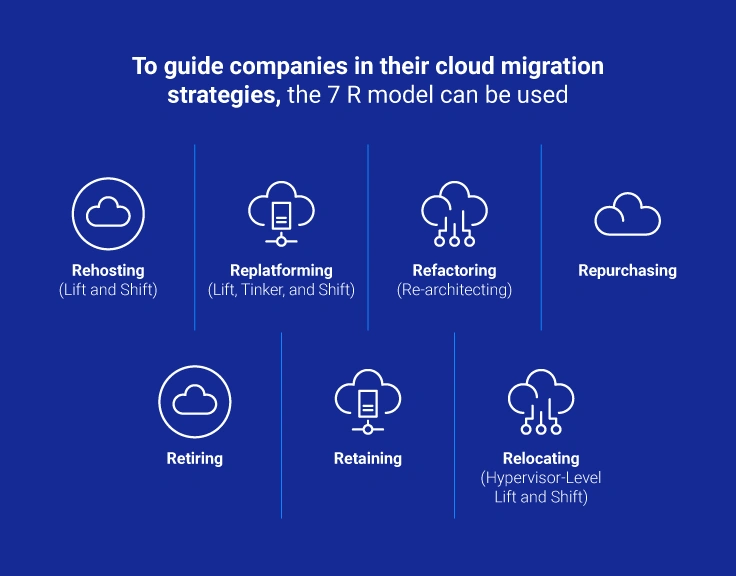
A migration plan often involves deciding how each workload will be treated. Common approaches include:
- Rehosting existing systems in the cloud
- Replatforming with limited modifications
- Refactoring applications for cloud native performance
- Replacing old tools with cloud based software services
- Retiring systems that are no longer needed
This decision shapes cost, effort, and long term outcomes.
Step 4: Prepare security and governance
Safe Cloud Migration requires:
- Access controls and identity management
- Data protection planning
- Backup and recovery policies
- Compliance alignment
- Monitoring and audit capabilities
- Governance around usage and ownership
Security should be built into the migration process, not added afterward.
Step 5: Migrate in phases
Businesses should generally:
- Start with lower risk workloads
- Test migrations before full deployment
- Validate performance and functionality
- Monitor for disruptions
- Move critical systems only after stable results are confirmed
A phased approach lowers risk and improves learning.
Step 6: Optimize after migration
Migration is not complete once systems are moved. Organizations should:
- Review performance and cost patterns
- Improve workload configuration
- Strengthen monitoring
- Update policies and operational processes
- Train teams on the new environment
This ensures the cloud environment delivers the intended value.
Safety Considerations in Cloud Migration
Moving safely requires technical readiness as well as organizational discipline.
Common risks to manage
Businesses should watch for:
- Data loss or corruption
- Misconfigured access controls
- Unexpected downtime
- Cost overruns
- Application compatibility issues
- Incomplete staff training
These risks can be reduced with planning, testing, and oversight.
Why safety matters
A safe migration approach helps organizations:
- Protect business continuity
- Maintain customer trust
- Meet regulatory expectations
- Avoid costly disruptions
- Build confidence in cloud adoption
This is why migration success depends on governance as much as technology.
Main Migration Stages Overview
Below is a concise overview of the main stages in Cloud Migration.
| Stage | Main Role | Why It Matters |
|---|---|---|
| Assessment | Reviews current systems and dependencies | Establishes a clear migration baseline |
| Goal Definition | Aligns migration with business priorities | Prevents unfocused execution |
| Strategy Selection | Determines how workloads will move | Shapes cost, speed, and complexity |
| Security Preparation | Protects systems, data, and access | Reduces operational and compliance risk |
| Phased Execution | Moves workloads gradually and carefully | Improves stability and control |
| Optimization | Improves results after the move | Ensures long term cloud value |
Together, these stages explain why Cloud Migration should be treated as a managed business transition rather than a simple infrastructure change.
Why Cloud Migration Continues to Matter
Cloud Migration continues to matter because businesses increasingly need systems that are flexible, resilient, and capable of supporting modern digital operations. Legacy environments often limit speed and scalability, while cloud platforms can provide a more adaptive and service oriented foundation.
Lasting significance
It remains important because it:
- Supports business modernization
- Enables more scalable infrastructure
- Improves operational agility
- Reduces dependence on aging hardware
- Strengthens long term digital readiness
Broader perspective
Cloud Migration demonstrates that technology change is most successful when it is approached as a structured transformation rather than a rushed upgrade. Safe movement to the cloud requires assessment, planning, phased execution, and continuous improvement, which is why thoughtful strategy matters as much as technical capability.
Key Takeaways
Cloud Migration helps businesses modernize safely by following a structured process that includes assessment, strategy, security planning, phased execution, and post migration optimization.
Main lessons
- Cloud Migration is the process of moving systems and workloads to cloud environments
- A safe migration starts with system assessment and clear business goals
- Migration strategies vary depending on workload needs and complexity
- Security and governance are essential throughout the process
- Phased execution and optimization improve stability and long term value
Final perspective
The key takeaway is that Cloud Migration is not just about moving technology. It is about building a safer, more flexible operational foundation for the future. When handled step by step and with careful governance, it can help businesses modernize with confidence.
Explore our “”Technology“” category for more insightful content!
Don't forget to check out our previous article: Python Programming: Mastering Python for Web Development, Data Science, and Automation
