


JAKARTA, odishanewsinsight.com – Weather Prediction: Forecasting Atmospheric Conditions with Technology feels like playing detective, right? Trust me, guys, I’ve chased rainy days and hot streaks since college—and messed up more than a few weekend plans thanks to dodgy apps. But here’s what I’ve honestly learned and why it matters so much for us in Indonesia.
Weather prediction is often taken for granted—tap an app, read tomorrow’s high and low, and move on. But behind that simple forecast lies a vast, intricate dance of observations, supercomputers, and statistical wizardry. In this account, I’ll walk you through my firsthand experiences wrestling with numerical weather prediction (NWP) models, data assimilation headaches, and the joys (and occasional humiliations) of chasing a more accurate forecast.
From Observations to Initial Conditions
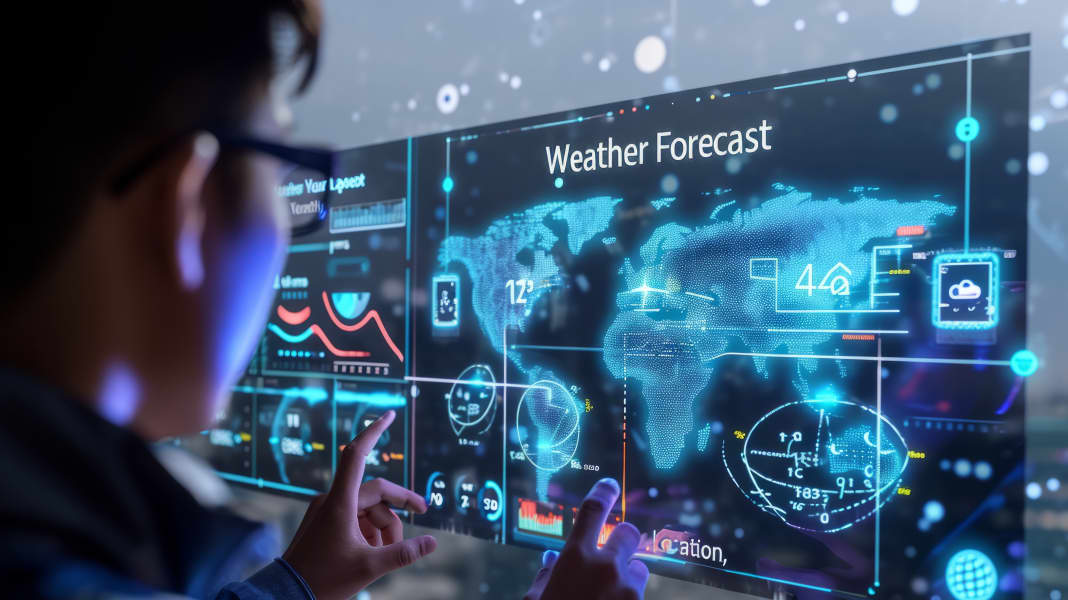
Every run of a weather model begins with an analysis—a best estimate of the atmosphere at a given time. To construct that snapshot, we ingest millions of observations: surface stations, radiosondes, commercial aircraft reports, Doppler radar sweeps, satellite radiances, even drifting buoys. In my early days at the meteorological center, I watched as a single missing aircraft temperature report over the Pacific would introduce a cold bias in the mid-troposphere, skewing the entire forecast out to five days.
Data assimilation systems, like 4D-Var or Ensemble Kalman Filters, blend those observations with a short “background” forecast to produce an analysis. Configuring the assimilation window—choosing how much weight to give each data source and over what time span—felt like tuning a delicate instrument. Give too much emphasis to an errant sensor, and the model spits out unrealistic pressure gradients. Give too little, and small-scale features like developing thunderstorms go unrepresented.
Numerics, Grids, and the Curse of Resolution
With the analysis in hand, the forecast model steps in. I cut my teeth on the Weather Research and Forecasting (WRF) model, which solved the Navier-Stokes equations for a grid covering my region. Deciding on horizontal resolution proved a constant tension between accuracy and computational cost. A 3-km grid will resolve convective cells far better than a 12-km grid, but it also multiplies CPU hours and I/O traffic. My first attempt at a convection-allowing run on our local cluster consumed 5,000 core-hours in 12 wall-clock hours—and promptly triggered an over-quota alert on our shared scratch filesystem.
Time stepping introduced its own puzzles. A larger time step speeds through the forecast but risks numerical instability in the presence of sharp fronts or steep terrain. I learned to calibrate the Courant-Friedrichs-Lewy (CFL) criterion carefully: every half-second cut in the time step improved stability but nudged my run duration upward. On more than one occasion, I woke up to a “floating point exception” error after an overnight job—only to discover that an overly aggressive time step had blown apart my pressure solver.
The Ensemble Approach and Forecast Uncertainty
No single deterministic forecast can capture the chaotic nature of the atmosphere. Enter ensembles: dozens—or even hundreds—of slightly perturbed model runs designed to sample the range of plausible outcomes. I still recall the thrill of plotting my first spaghetti diagram, where each line represented the 500-hPa geopotential height from a different ensemble member. The “plume” spread of lines over Alaska was a stark visualization of forecast uncertainty.
Running an ensemble is a logistical marathon. You need to orchestrate simultaneous model submissions, manage directory structures for terabytes of output, and automate post-processing to compute ensemble means, spreads, and probability maps. In one memorable fiasco, I forgot to update the namelist for half the members, so 50 percent of my ensemble ran with a stale microphysics scheme. The result was a split ensemble—half predicted heavy snow, half predicted nothing—which confused my colleagues more than it informed them.
Verification: Confronting Model Biases
Forecast skill only matters when you measure it. Verifying forecasts against observations—calculating biases, root-mean-square errors, and Brier scores—became my daily ritual. I plotted temperature bias maps that showed a systematic cold bias over urban areas and a wind speed underestimation in coastal jets. Those routines were invaluable for tuning physics parameterizations and nudging model developers toward improvements.
Perhaps the most humbling moment came when our lead forecaster challenged me: “Your model says a 90 percent chance of rain, but my gut says 50 percent. Let’s see who’s right.” We tallied outcomes over a season, and despite my faith in the model’s probabilities, human forecasters still outperformed the raw ensemble for certain convective events. That experience taught me the enduring value of forecaster expertise in interpreting model guidance.
Real-Time Forecasting in the Field
Technology isn’t confined to research labs. Last summer, I volunteered with a storm-chasing team during severe weather season. We carried tablets running a mobile NWP client that downloaded the latest short-range ensemble forecasts. In one case, an impressive low-level jet had developed overnight, but our home-base forecast hadn’t captured it. Thanks to the field-deployed system, we pivoted our intercept plan, arrived east of the jet’s axis, and recorded a jaw-dropping 78 mph gust line with our portable anemometers. That real-time flexibility demonstrated the power of blending model output with on-the-ground observations.
Takeaways and Tips for Aspiring Forecasters
- Prioritize small test cases before scaling up: run a single cell for six hours to debug namelist options.
- Automate verification early: daily stats reveal biases before they become entrenched habits.
- Embrace ensemble thinking: move from “what will happen?” to “what could happen, and how confident are we?”
- Document every environmental variable—from module loads to compiler flags—to ensure reproducible runs.
- Never underestimate the value of human expertise: models guide decisions, but human judgment refines them.
Weather prediction is an evolving tapestry of physics, statistics, high-performance computing, and human insight. Every forecast—from a simple tomorrow’s high to a complex probability cone for hurricane track—reflects countless hours of data wrangling, code optimization, and field validation. My own journey has been littered with compile errors, crashed jobs, and embarrassing mis-namelists, yet each setback revealed a deeper layer of the forecast machine. As technology marches forward—ushering in higher resolutions, better data assimilation, and machine-learning augments—the core challenge remains the same: to translate complex atmospheric dynamics into actionable guidance for everyone from farmers planning irrigation to families deciding whether to bring an umbrella. In the forecast game, precision matters, but so does humility—and the willingness to learn from every false alarm and every nailed prediction.
Explore our “Technology” category for more insightful content!
Don't forget to check out our previous article: Natural Language Processing: Enabling Computers to Understand Human Language
