

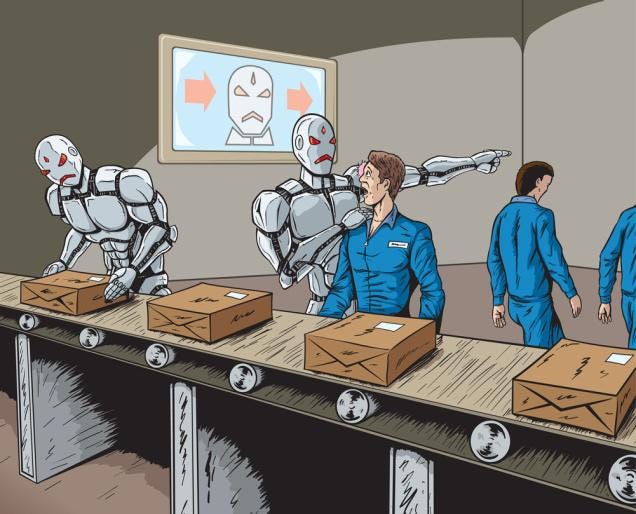
JAKARTA, odishanewsinsight.com – Technological Unemployment: The Impact of Automation on the Future of Work isn’t just some future horror sci-fi movie. It’s already happening, right under our noses. Trust me, as someone whose first job uploading data was replaced by, yep you guessed it, automation, I felt that sting.
As robots learn to reason and software writes its own code, the specter of Technological Unemployment looms larger each day. What once felt like science fiction is rapidly becoming our reality: machines replacing humans in repetitive tasks, AI augmenting decision-making, and entire industries being reshaped. In this article, we’ll unpack the forces driving automation, the sectors most at risk, and—crucially—what individuals, businesses, and policymakers can do to navigate this paradigm shift.
What Is Technological Unemployment?

Technological Unemployment occurs when advances in technology—robots, AI algorithms, or sophisticated machinery—displace human labor faster than the economy can create new roles. It is not merely job turnover; it’s a structural shift that can:
- Reduce demand for certain skill sets
- Increase inequality if reskilling lags behind
- Transform the very definition of “work” in the digital age
Key definitions:
- Displacement Effect: Workers lose jobs because machines perform the same function more cheaply or reliably.
- Productivity Effect: Automation creates new goods/services, potentially generating new employment in emerging fields.
- Reallocation Lag: Time gap between jobs lost and new roles created or workers retrained.
Timeline: Automation Milestones & Labor Impact
| Era | Breakthrough | Labor Impact |
|---|---|---|
| Late 18th c. | Industrial Revolution (steam engine) | Textile workers displaced; factory jobs rise |
| 1960s | Early industrial robots (Unimate) | Automotive line jobs automated |
| 1990s | Desktop computing & the Internet | Clerical, typing, and record-keeping shifts |
| 2010s | Machine learning & AI assistants | Call-center, basic diagnostic roles at risk |
| 2020s–2030s (now) | Generative AI & advanced robotics | Creative, analytical, and service tasks |
Drivers & Mechanisms of Automation
- Artificial Intelligence
- Natural language processing (chatbots, virtual agents)
- Computer vision (warehouse sorting, inspection)
- Robotics & Mechatronics
- Collaborative robots (“cobots”) on manufacturing floors
- Autonomous vehicles in logistics and delivery
- Process Automation
- Robotic Process Automation (RPA) for repetitive office tasks
- Algorithmic trading in financial markets
- Platform Economies
- Gig-work algorithms matching supply and demand—often optimizing for cost over labor stability
Sectors Most at Risk
| Sector | At-Risk Roles | Automation Drivers |
|---|---|---|
| Manufacturing | Assembly line operators, packers | Cobots, vision systems |
| Transportation & Logistics | Truck drivers, warehouse pickers | Self-driving vehicles, drones |
| Administration & Support | Data entry clerks, schedulers | RPA, AI chatbots |
| Retail | Cashiers, shelf stockers | Self-checkout, inventory robots |
| Finance & Insurance | Basic analysts, claims processors | Algorithmic underwriting, robo-advisors |
| Customer Service | Tier-1 support agents | Virtual assistants, sentiment analysis |
Benefits & Challenges
Benefits
- Higher productivity and lower unit costs
- 24/7 service availability with minimal human supervision
- Fewer human errors in repetitive tasks
- New industries enabled by advanced tech (AI research, robot maintenance)
Challenges
- Job displacement without immediate alternatives
- Growing skills gap and reskilling bottlenecks
- Potential wage stagnation for mid-level roles
- Socioeconomic inequality if gains accrue to capital owners
Mitigation Strategies & Best Practices
- Lifelong Learning & Reskilling
• Public–private training partnerships for digital and soft skills
• Micro-credentials, nano-degrees, and on-the-job apprenticeships - Job Redesign
• Combine human creativity with machine precision (human-in-the-loop systems)
• Elevate roles that require emotional intelligence, critical thinking, and complex judgment - Policy Interventions
• Portable benefits (unemployment insurance, health coverage) decoupled from single employers
• Incentives for businesses that upskill displaced workers
• Exploratory pilots of Universal Basic Income (UBI) or wage insurance - Corporate Responsibility
• Transparent automation roadmaps and workforce impact assessments
• Phased integration of robots with clear change-management plans - Innovation Ecosystems
• Foster entrepreneurship in emerging tech sectors
• Support small and medium enterprises (SMEs) adopting augmentation over replacement
Case Study: From Factory Floor to AI-Assisted Technician
Company: Global automotive parts manufacturer
Challenge: High turnover among line workers and rising labor costs
Solution Pathway:
- Pilot Cobots to handle repetitive welding tasks, working alongside operators.
- Upskill Operators into “robot shepherd” roles—programming and maintaining cobots.
- Rotate Staff through quality-assurance and predictive-maintenance teams, using data analytics tools.
Results:
- 20% increase in throughput
- 15% reduction in frontline headcount, offset by 25% new roles in tech support and analytics
- Employee satisfaction up 12% due to skill-building opportunities
Emerging Trends & Future Outlook
- Generative AI creating first drafts of reports, marketing copy, and code—shifting humans toward editing and strategy.
- Edge Robotics in agriculture and construction—robots adapting on-site with minimal connectivity.
- Human-Machine Teaming Platforms that distribute tasks dynamically between people and machines.
- Hybrid Work Models blending remote human oversight with on-premise robots.
- Ethical Automation Frameworks emphasizing transparency, fairness, and human dignity.
Why You Should Care
- No industry is immune: from healthcare diagnostics to creative arts, automation accelerates.
- Early adopters of augmentation strategies gain competitive advantage in cost, quality, and innovation.
- Collective action—across government, academia, and business—will shape whether automation empowers or marginalizes.
- Individual agency: proactive skill-building positions you to collaborate with, not compete against, machines.
Final Takeaways
Technological Unemployment isn’t a distant warning—it’s unfolding now. While machines excel at pattern recognition and repetitive tasks, they struggle with empathy, ethics, and creativity. The future of work hinges on our ability to:
- Embrace lifelong learning and develop skills uniquely human
- Redesign jobs to leverage human-machine strengths in tandem
- Advocate for policies that safeguard worker well-being during transitions
- Cultivate ethical automation practices within organizations
By facing the challenge head-on, we can steer automation toward a future where technology amplifies human potential instead of replacing it. The clock is ticking—start preparing today.
Elevate Your Competence: Uncover Our Insights on Technology
Read Our Most Recent Article About Software Engineering: Building Reliable Software Systems !
